Triovonixx
Peak Sphere
Peak Sphere
Couldn't load pickup availability
- :card_index_dividers: Digital file available after purchase
- :books: Long-term availability
- :closed_lock_with_key: Secure checkout
- :sparkles: Content updated in 2026
Self-paced learning overview
1. Problem Statement
At a later learning stage, learners often find that separate skills are familiar, but combining them in one scene can be difficult. The form may be neat, the light may read clearly, and the modules may be organized, yet the full piece may still need stronger connection between parts. In a more detailed scene, it is important to observe composition, rhythm, layers, proportions, movement, and details at the same time. If these topics are handled separately, the scene may feel divided into parts rather than cohesive. Peak Sphere was created to help learners bring different principles of 3D modeling into one sequential learning process.
2. Solution
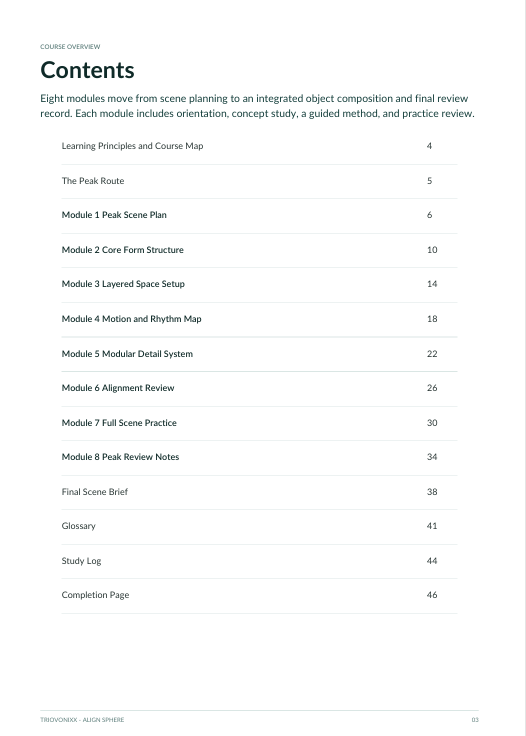
Peak Sphere offers an expanded learning route for creating a 3D scene with several objects, layers, rhythm, and visual logic. In this plan, learners work through a full learning scene cycle: from idea and main form to spatial order, details, and final review. The materials help combine previous topics without moving between them chaotically. Each module has a separate role and gradually leads toward an organized scene with a clear structure. This format is suitable for attentive learning where the focus is not the number of elements, but how well they work together.
3. What’s Inside
- Module 1: Peak Scene Plan — how to define the idea of a learning scene, choose the main object, supporting elements, and the overall spatial direction.
- Module 2: Core Form Structure — how to build the main form of the scene while keeping proportions, silhouette, and readable construction.
- Module 3: Layered Space Setup — how to divide the scene into foreground, middle space, and background so each level has its role.
- Module 4: Motion and Rhythm Map — how to add direction, rhythm, and visual movement through form tilt, repetition, and object placement.
- Module 5: Modular Detail System — how to use repeated elements, grid logic, and modular parts without overloading the scene.
- Module 6: Alignment Review — how to review axes, scale, distances, symmetry, variation, and visual weight between elements.
- Module 7: Full Scene Practice — a learning exercise for creating a cohesive 3D scene where form, layers, movement, modules, and details work together.
- Module 8: Peak Review Notes — final self-review by 10 points: idea, form, proportions, layers, depth, rhythm, movement, modules, alignment, and scene clarity.
4. Who Is This For?
✅ A good fit if you...
- are already familiar with basic form, composition, layers, movement, and modular construction;
- want to combine several topics in one learning scene;
- are interested in more detailed 3D compositions;
- want to review scenes more carefully through different parameters;
- are ready to work with a longer learning exercise and several construction stages.
❌ Not for you if...
- you are just starting with 3D modeling;
- you want to work only with one simple object;
- you do not plan to analyze composition, layers, rhythm, and alignment;
- you are looking for a short introductory material without expanded modules;
- you expect completed works instead of learning materials.
5. What You’ll Learn
- how to plan a 3D scene with several connected elements;
- how to combine the main form, details, and space;
- how to organize foreground, middle space, and background;
- how to add rhythm and direction to a static scene;
- how to use modular parts and repetition;
- how to review alignment, scale, and visual weight;
- how to create a learning scene through 8 sequential stages;
- how to evaluate your work using 10 specific self-review points.
6. Purchase Note
- 30-day money back
7. Certificate of Completion
After completing all Peak Sphere modules and the full study scene, the learner receives a digital Certificate of Completion. The document reflects combined work with form, light, layers, movement, modular details, alignment, and final composition review.
Do I need previous experience in 3D modeling?
Do I need previous experience in 3D modeling?
No, some plans are built for starting with basic concepts, while higher plans gradually add more topics, tasks, and materials. You can choose the format based on your current familiarity with 3D modeling.
What is included in the plans?
What is included in the plans?
Each plan has its own set of modules, learning materials, task descriptions, and practice directions. As the plan level increases, the course content becomes broader and includes more topics to explore.
Share