Triovonixx
Origin Guide
Origin Guide
Couldn't load pickup availability
- :card_index_dividers: Digital file available after purchase
- :books: Long-term availability
- :closed_lock_with_key: Secure checkout
- :sparkles: Content updated in 2026
Self-paced learning overview
1. Problem Statement
After studying basic forms and simple scenes, a learner may face the question of how to begin a personal 3D piece without confusion. The idea may be present, but it can be difficult to turn it into an object with a clear structure. Without an initial plan, the form may change randomly, details may be added too early, and the scene may lose its logic. A learner may spend a lot of time revising because the sequence between idea, form, and final learning exercise is unclear. Origin Guide was created to help learners move calmly from an initial idea to an organized 3D object.
2. Solution
Origin Guide offers a learning route where the main focus is the beginning of work on a 3D object. The materials explain how to define an idea, identify the main form, organize details, and gradually assemble an object. The course helps learners avoid jumping directly into complex elements and instead keep a steady construction sequence. Learners study how to create a simple plan for a learning piece and review each stage. This approach makes the process clearer and reduces randomness in construction.
3. What’s Inside
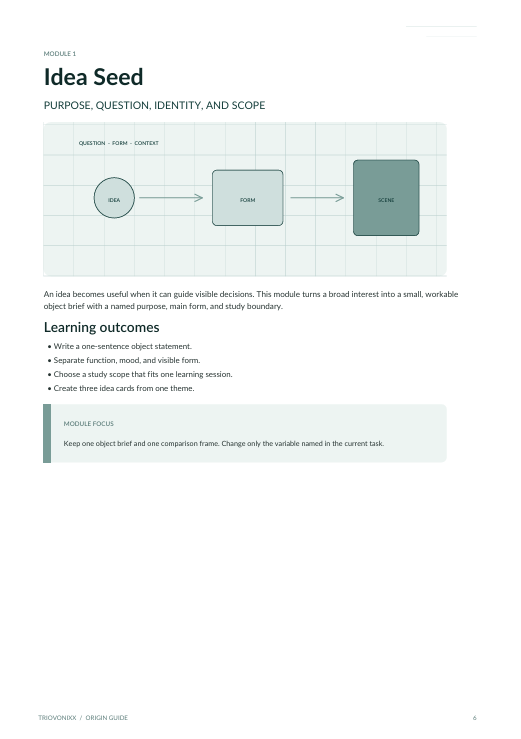
- Module 1: Idea Seed — how to define an initial idea for a 3D object and decide what should be central in the form.
- Module 2: Reference Thinking — how to analyze visual sources without copying and identify form, proportions, mood, and details.
- Module 3: Main Shape Plan — how to choose the base form of an object and build the first clear framework.
- Module 4: Structure Flow — how to divide an object into parts so each element has its place in the overall structure.
- Module 5: Detail Timing — when to add details so they support the form rather than disturb its visual order.
- Module 6: Scene Start — how to prepare a simple scene around the object without overloading the space with extra elements.
- Module 7: Origin Practice Build — a learning exercise for creating a 3D object from idea to basic scene.
- Module 8: Origin Review Notes — self-review by key points: idea, main form, structure, details, scene, and overall readability.
4. Who Is This For?
✅ A good fit if you...
- are already familiar with basic forms, light, and simple scenes;
- want to begin personal 3D learning pieces in a more structured way;
- are interested in the path from idea to object;
- want to better plan form, details, and scene;
- are ready to work with phased learning exercises.
❌ Not for you if...
- you want to work without initial planning;
- you are looking only for short tips without modules;
- you do not want to analyze idea and structure;
- you expect finished final works instead of learning materials;
- you want to skip the basic stages of object construction.
5. What You’ll Learn
- how to define an idea for a 3D object;
- how to identify the main form before detailing;
- how to divide an object into clear parts;
- how to plan the creation sequence;
- how to decide when to add details;
- how to prepare a simple scene for a learning piece;
- how to move from concept to an organized object;
- how to review work by idea, form, structure, and scene.
6. Purchase Note
- 30-day money back
7. Certificate of Completion
After completing Origin Guide and creating the final study piece, the learner receives a digital Certificate of Completion. The document includes the course title and records the learning route from an initial idea to a structured 3D object.
Do I need previous experience in 3D modeling?
Do I need previous experience in 3D modeling?
No, some plans are built for starting with basic concepts, while higher plans gradually add more topics, tasks, and materials. You can choose the format based on your current familiarity with 3D modeling.
What is included in the plans?
What is included in the plans?
Each plan has its own set of modules, learning materials, task descriptions, and practice directions. As the plan level increases, the course content becomes broader and includes more topics to explore.
Share