Triovonixx
Layer Framework
Layer Framework
Couldn't load pickup availability
- :card_index_dividers: Digital file available after purchase
- :books: Long-term availability
- :closed_lock_with_key: Secure checkout
- :sparkles: Content updated in 2026
Self-paced learning overview
1. Problem Statement
When a 3D scene begins to include more elements, it becomes harder for learners to keep order between forms. The main object may get lost among details, foreground and background may blend together, and the scene may feel overloaded. The issue often comes not from the number of objects, but from weak layer organization. Without understanding spatial hierarchy, it is difficult to decide what should be central and what should simply support the composition. Layer Framework was created to help learners build a scene through clear levels, from the foundation to the details.
2. Solution
Layer Framework offers a structured approach to organizing 3D scenes through layers. In this plan, learners study how to separate a scene into foreground, middle space, and background, how to define the main object, and how to place supporting forms. The materials help learners see a scene not as a set of separate parts, but as a system with internal order. Each module shows how to shape space layer by layer without overloading the composition. This route is suitable for learners who want to work more carefully with depth, visual focus, and clean scene structure.
3. What’s Inside
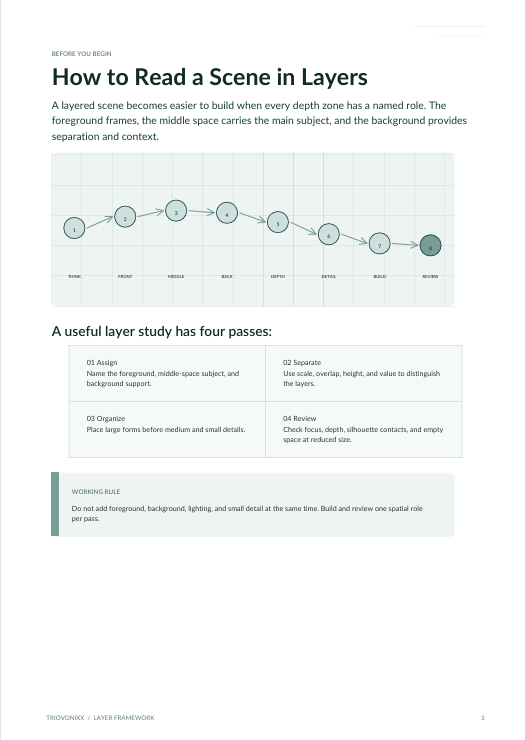
- Module 1: Layer Thinking — how to think about a scene in layers and understand which elements should be central, supportive, or background-based.
- Module 2: Foreground Structure — how to build the foreground so it adds depth without taking attention away from the main form.
- Module 3: Middle Space Logic — how to organize the middle space, where the main object or key group of forms is often placed.
- Module 4: Background Order — how to work with the background so it supports the scene without extra visual noise.
- Module 5: Depth Markers — how to use size, distance, overlap, and shadows to create a sense of space.
- Module 6: Detail Hierarchy — how to distribute details between layers so they do not compete with the main object.
- Module 7: Layered Scene Practice — a learning exercise for creating a scene where foreground, middle space, and background each have a clear role.
- Module 8: Framework Review Notes — self-review by key points: layers, depth, main object, supporting forms, details, and overall scene clarity.
4. Who Is This For?
✅ A good fit if you...
- have already worked with simple 3D scenes;
- want to organize foreground, middle space, and background more clearly;
- are interested in depth, composition, and visual hierarchy;
- want to learn how to distribute details between layers;
- are ready to complete exercises with a more detailed scene structure.
❌ Not for you if...
- you want to work only with one object without surrounding space;
- you do not plan to study scene composition;
- you are looking only for materials about separate forms without context;
- you do not want to analyze layers, depth, and the role of details;
- you expect finished works instead of learning modules.
5. What You’ll Learn
- how to divide a 3D scene into clear layers;
- how to work with foreground, middle space, and background;
- how to define the main object in a scene;
- how to place supporting forms without overload;
- how to create a sense of depth through size, distance, and overlap;
- how to distribute details by their role;
- how to build a learning scene with several spatial levels;
- how to review a scene by layers, depth, visual focus, and clean composition.
6. Purchase Note
- 30-day money back
7. Certificate of Completion
The Layer Framework certificate is provided after completing the eight modules and the layered scene exercise. It reflects work with foreground, middle space, background, depth, and detail hierarchy.
Do I need previous experience in 3D modeling?
Do I need previous experience in 3D modeling?
No, some plans are built for starting with basic concepts, while higher plans gradually add more topics, tasks, and materials. You can choose the format based on your current familiarity with 3D modeling.
What is included in the plans?
What is included in the plans?
Each plan has its own set of modules, learning materials, task descriptions, and practice directions. As the plan level increases, the course content becomes broader and includes more topics to explore.
Share