Triovonixx
Align Sphere
Align Sphere
Couldn't load pickup availability
- :card_index_dividers: Digital file available after purchase
- :books: Long-term availability
- :closed_lock_with_key: Secure checkout
- :sparkles: Content updated in 2026
Self-paced learning overview
1. Problem Statement
When a scene contains many forms, modules, and details, even small shifts can affect its readability. Objects may look almost correct but still have weak alignment, uneven visual rhythm, or unclear proportional logic. Because of this, the scene can sometimes feel unorganized, even if separate elements are built carefully. It may be difficult for learners to see where the order is disrupted: scale, axis, distance, tilt, or repetition. Align Sphere was created to help learners work carefully with form consistency and clean compositional construction.
2. Solution
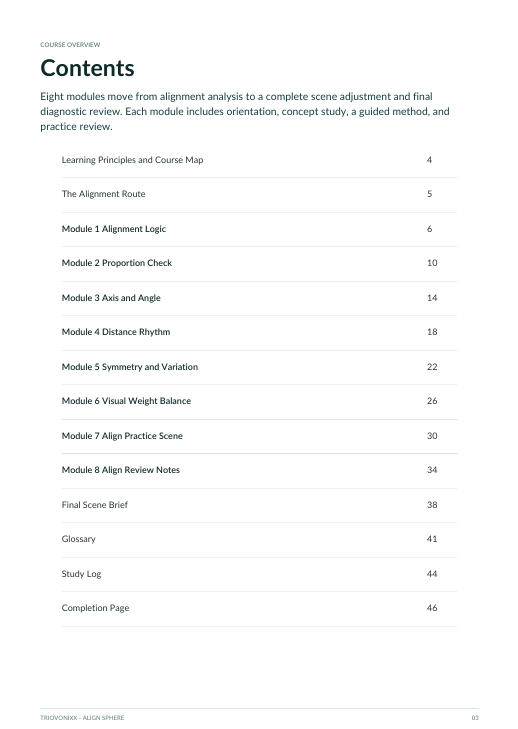
Align Sphere offers a structured route for analyzing and adjusting a 3D scene through alignment, proportions, and relationships between elements. The materials explain how axes, distances, rhythm, repetition, symmetry, and visual weight work. The course helps learners review a scene not only in general, but also through specific parameters: position, scale, direction, and the role of each form. The modules gradually show how small adjustments can make a learning piece more organized. This approach supports attentive scene editing without unnecessary complexity.
3. What’s Inside
- Module 1: Alignment Logic — how to see axes, direction, and the relative position of forms in a 3D scene.
- Module 2: Proportion Check — how to review height, width, depth, and size relationships between objects.
- Module 3: Axis and Angle — how tilt, rotation, and element direction affect the overall order of a scene.
- Module 4: Distance Rhythm — how distances between objects create rhythm, pauses, and visual balance.
- Module 5: Symmetry and Variation — how to work with symmetry, repetition, and small form changes without losing unity.
- Module 6: Visual Weight Balance — how to distribute large and small elements so the scene does not feel heavier on one side.
- Module 7: Align Practice Scene — a learning exercise for adjusting a scene through axis, scale, distance, rhythm, and proportions.
- Module 8: Align Review Notes — self-review by key points: alignment, proportions, axis, angle, rhythm, symmetry, weight, and scene clarity.
4. Who Is This For?
✅ A good fit if you...
- have already worked with composition, layers, movement, and modular forms;
- want to adjust 3D scenes with more precision;
- are interested in alignment, proportions, axes, and rhythm;
- want to better notice small issues in construction;
- are ready to complete exercises with scene analysis and editing.
❌ Not for you if...
- you want to work only with the simplest single objects;
- you do not plan to analyze proportions and alignment;
- you are looking only for an introduction to 3D modeling;
- you do not want to review a scene through specific parameters;
- you expect finished works instead of learning modules.
5. What You’ll Learn
- how to analyze form alignment in a 3D scene;
- how to review proportions between objects;
- how to work with axes, angles, and direction;
- how to create rhythm through distances;
- how to combine symmetry and variation;
- how to distribute visual weight between elements;
- how to edit a scene through small adjustments;
- how to review a learning piece by alignment, scale, rhythm, and clean composition.
6. Purchase Note
- 30-day money back
7. Certificate of Completion
Learners who complete Align Sphere and the final scene adjustment exercise receive a digital Triovonixx certificate. It records work with proportions, axes, angles, distances, symmetry, and visual balance.
Do I need previous experience in 3D modeling?
Do I need previous experience in 3D modeling?
No, some plans are built for starting with basic concepts, while higher plans gradually add more topics, tasks, and materials. You can choose the format based on your current familiarity with 3D modeling.
What is included in the plans?
What is included in the plans?
Each plan has its own set of modules, learning materials, task descriptions, and practice directions. As the plan level increases, the course content becomes broader and includes more topics to explore.
Share